
Comparing private credit investment returns across funds, ETFs, and platforms
To understand how private credit investments stack up, we compare returns, risk metrics, and portfolio construction strategies across investment type.

While the world’s largest private credit ETF (BIZD) fell 4.7% in 2025 and many funds struggled with rising defaults, Heron Finance's private credit program delivered 9.1% returns net of fees — with meaningfully lower risk across many key metrics, a reflection of how conservatively we positioned the portfolio.
Table of contents:
- Comparing private credit investment returns in 2025
- Private credit investment key risk metric comparison
- How private credit portfolio construction drives performance
Comparing private credit investment returns in 2025
To compare private credit investments, we analyzed 2025 returns of the funds available on Heron versus 61 of the world’s largest professionally managed funds, the largest private credit ETF, and the Yieldstreet Alternative Income Fund Inc.*
The results were clear…
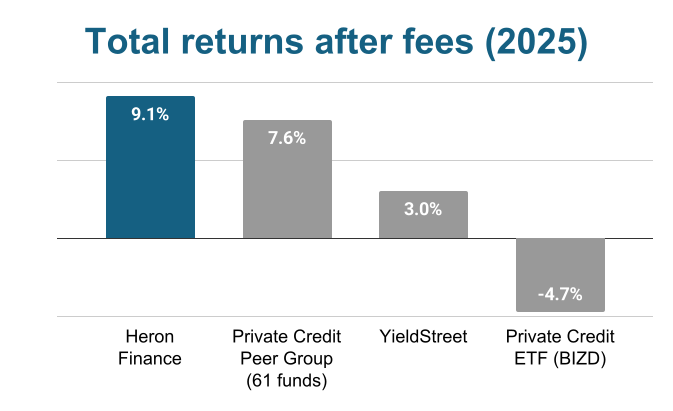
For the full 2025 calendar year (the most recent reporting period with data), Heron Finance's private credit program outperformed benchmarks across private credit markets:
- Heron Finance: 9.1% after fees and expenses
- Private Credit Peer Group (61 funds): 7.6% average across the funds
- YieldStreet: 3.0%
- Private Credit ETF (BIZD): -4.7%
Heron Finance can build you a private markets investing portfolio in 3 easy steps.
Private credit investment key risk metric comparison
Heron’s strong returns didn’t come at the cost of higher risk.
Compared to the private credit fund peer group, for example, funds on the Heron platform show significantly-lower risk across key metrics:
Table disclosure: Data from SEC filings and fund reporting. Returns shown for the trailing 12-month period ending on 12/31/2025 based on NAV and distributions. See full disclosure for peer group and metric details.* See Metric explanations >
How private credit portfolio construction drives performance
While the largest private credit ETF lost 4.7% and peers averaged 7.6% gains, Heron's 9.1% net return wasn't luck — it was built on rigorous portfolio construction. While our process doesn't guarantee success, the risk and return results are in line with our goals.
Heron private credit investing portfolios were built from day one on a diligent approach to credit evaluation.
We select funds to include in our client’s portfolios using a proprietary scoring model and in-depth manager due diligence.
This foundation keeps us focused on portfolio management, not industry noise.
Over the past year, that noise was hard to ignore: high-profile bankruptcies, dramatic BDC selloffs, rising defaults in funds we don't invest in, and cautionary comments from a big bank CEO.
We watched all of it — and stayed the course.
The result? Heron portfolios outperformed peers.
And our results reinforce two of our core principles:
- Broad diversification
- Experienced fund managers
Broad diversification and experienced fund managers are not buzzwords — they are the two variables that most explain our 2025 results.
Heron gives investors automated exposure across nearly 4,000 global private credit assets, sourced exclusively from established firms that collectively manage more than $1 trillion in the asset class.
Before you invest in private credit...
Take a few minutes to set up an account with Heron to get a no-fee portfolio recommendation. See your prospective portfolio before you decide to invest.
If you decide to invest, we charge a low 1% annual management fee.**
It only takes minutes to get a portfolio recommendation.
In addition to private credit, we offer exposure to leading private equity, infrastructure, and real estate funds to help expand your diversification across established fund managers.
And in case you prefer to customize your portfolio, we offer two options:
- Get a portfolio recommendation based on your goals with the ability to customize as you go.
- Build your own portfolio from multiple asset classes across 25+ professionally managed funds.
Once you fund your portfolio, we do everything for you, from initial allocations to ongoing management.
Trusted by investors like you

Featured on


Get a private market portfolio recommendation
Heron builds you an automated private market investing portfolio diversified across thousands of global assets designed to hedge against volatility and inflation.
Metric explanations
- Underperformance: Percentage of total investments portfolio performing below fund manager's expectations, based on fair market value.
- PIK interest: PIK interest income as a percentage of gross total investment income. PIK interest (Payment-in-Kind) is a financial term where a borrower pays interest on a loan or bond by issuing more debt or equity rather than cash. This allows companies to conserve cash, but it increases the total debt principal over time, making it riskier and often resulting in higher overall interest costs.
- Non-accruals: Non accruals as a percentage of total investments portfolio, based on cost. Private credit non-accruals represent loans where borrowers have stopped paying interest/principal.
- Loss rate: Trailing 12-month realized investment loss, net of gain, as a percentage of average fund net asset value
*Data from SEC filings and fund reporting. Returns shown for the trailing 12-month period ending on 12/31/2025 based on NAV and distributions. Yieldstreet based on total returns of GOVT ETF and Yieldstreet Alternative Income Fund Inc., respectively. Returns shown as total returns based on NAV for Heron, Yieldstreet, and peer group, and based on market prices for others. Dataset includes 73 of the largest U.S. private credit funds that Heron Finance has fully underwritten (61 of which are the peer group and 12 of which are the funds on Heron), which are actively managed by firms that collectively manage in excess of $1 trillion in private credit assets across relevant funds and accounts. Peer Group funds were selected for comparison because of their overlapping approaches with the funds in Heron’s private credit strategies (e.g., lower middle market, core middle market, and upper middle market), and collectively they represent a majority of the private credit industry in the U.S. A full list of the peer group is available upon request. Heron return is based on actual portfolio, taking into considerations weights of private credit funds over the course of the year. Risk metrics for Heron Finance vs. Peer Group based on average (mean) data. “Underperforming Assets” based on underlying fund managers’ assessment, shown in terms of fair market value; “PIK Interest” shown as payment in kind interest income divided by total investment income; “Non-Accruals” based on non-accruals by amortized cost; “Loss Rate” based on realized investment loss, net of gain, divided by average fund net asset value on a trailing four-quarter basis. Comparison of the Heron’s performance to any particular index, financial instrument, or third-party fund (each a "Benchmark") performance is not without complications. Among other things, there may be variance in active vs. passive management, potentially more or less diversification than the Benchmark, difference in expenses incurred, disparity in access to investment opportunities, liquidity profile of investing and/or of underlying investments, and possibly additional limitations or restrictions. Accordingly, any such comparisons are for informational purposes only and should not be construed as having a direct association.
**Clients should review the IMA (or ADV) for more details on fees and expenses.