

Monthly insights: Is private infrastructure investing the answer to inflation? (May 2026)
With inflation making headlines, we look at why private infrastructure may be an attractive investment.
Monthly Insights #14, May 2026
In this issue:
- Is private infrastructure investing the answer to inflation?
- What private infrastructure is — and how it's different from private equity
- Two reasons private infrastructure has historically held up in inflationary environments
- AI is driving an unprecedented infrastructure build-out
- Fund facts: $106 trillion
- Quote of the month: The $5 haircut
Is private infrastructure investing the answer to inflation?
Inflation is back on the front page with the Consumer Price Index rising 3.8% year-over-year — the highest 12-month reading since May 2023.
This raises a question:
What should you invest in?
One answer: private infrastructure
Private infrastructure is drawing growing attention from financial advisors and institutional allocators:
- A recent survey found that private infrastructure has quietly become the most sought-after allocations, with 75% of the advisors expecting their clients to increase allocations to this asset class.
- Blackstone published that institutional investors have increased their average private infrastructure allocations by 1.5x since 2019, with levels expected to double by 2029.
Let’s explore why private infrastructure is attractive during inflationary periods…
First, what is private infrastructure and how is it different from private equity?
It’s common to lump private infrastructure in with private equity, and while they share some structural similarities, they play different roles in a diversified portfolio.
- Private infrastructure generally refers to privately held, long-lived physical assets that provide essential services to the economy — such as power generation, regulated utilities, toll roads, airports, water systems — and aims to deliver stable cash flows while offering potential upside and inflation-hedging characteristics.
- Private equity, on the other hand, refers to ownership of private companies across a range of industry sectors and aims to generate attractive long-term returns primarily through capital gains.
Learn more: Read our explainer on Private Infrastructure vs Private Equity.
Why has private infrastructure historically held up in inflationary environments?
Two structural reasons stand out.
1. Inflation linkage is often explicitly built into the contracts.
Cash flows from infrastructure assets are typically tied to inflation — think regulated utility rates, toll-road escalators, contracted power purchase agreements, airport tariffs. When prices rise, these cash flows tend to rise with them.
2. Essential services tend to have pricing power.
Demand for electricity, water, data transmission, and transportation tends to be inelastic, meaning it doesn't fall meaningfully when prices rise. Combined with high barriers to entry (you can't easily build a competing transmission grid or toll road), this gives infrastructure operators a near-monopoly degree of pricing power. As a result, even without explicit inflation protection, many infrastructure asset owners are able to pass through rising costs due to their strong market positions.
And for investors, historical performance has reflected those structural traits.
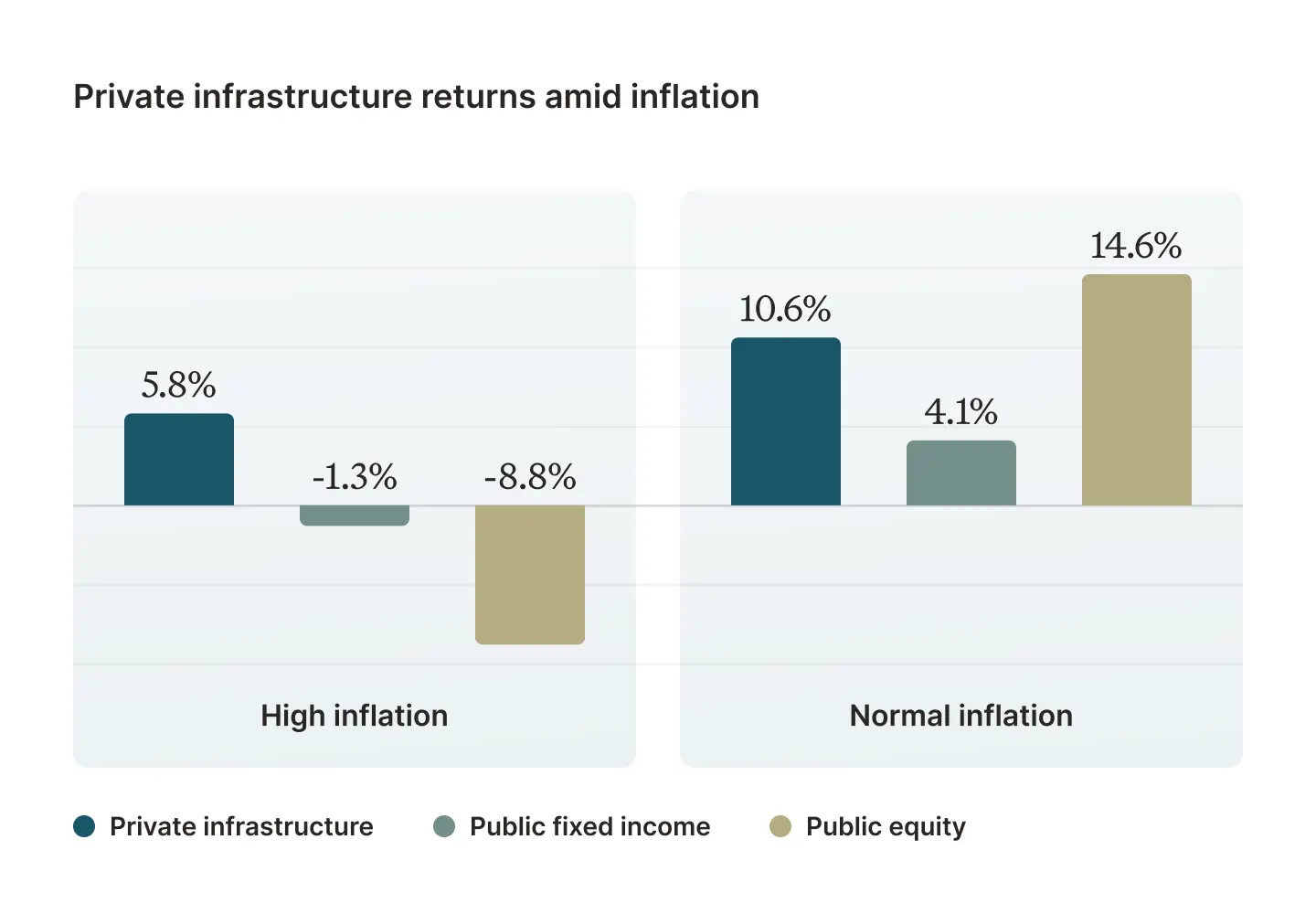
During times of high inflation, looking at the 20-year period from 2004 to 2024 in the chart below, private infrastructure has outperformed both public fixed income and public equities.
An unprecedented tailwind: AI is driving an infrastructure build-out
The inflation case isn't the only thing pulling capital into private infrastructure. The AI build-out has become a primary demand driver in its own right.
Driven by rapid growth in AI, cloud computing, and data consumption, global computing requirements are soaring. According to Data Center Dynamics, worldwide contracted data center capacity is projected to increase by more than 200% between 2025 and 2035.
Hamilton Lane's global head of infrastructure and real assets recently told S&P Global Market Intelligence that "with everything moving so quickly in technology and AI, asset ownership is a safer way to play."
That view captures part of the appeal:
Infrastructure offers a way to participate in the AI economy through the data centers, fiber, and power assets underneath it, without taking on single-model technology risk.
How Heron builds a private infrastructure investing strategy
At Heron, we offer accredited investors access to a globally diversified private infrastructure strategy with exposure to over 1,000 underlying assets through five established fund managers, spanning power and utilities, transportation, digital, and social infrastructure.
The average track record of the private infrastructure managers on our platform is 22+ years, meaning the firms running these portfolios have successfully navigated multiple rate and inflation cycles.
You can learn more about Heron’s private infrastructure approach.
As always, we'll keep watching how inflation evolves, where capital is flowing, and which fund managers continue to deliver durable, risk-adjusted outcomes.
Thanks for reading,
Heron Chief Credit Officer
From the Heron Blog
- Why invest in private infrastructure in 2026? 3 charts for investors
- Is private infrastructure the missing diversifier in your portfolio?
Heron fund facts
Fact: $106 trillion
Why that matters: The world will need massive investment in infrastructure—$106 trillion by 2040. Despite record-breaking infrastructure budgets, however, many countries face growing fiscal constraints. To bridge this staggering funding gap, governments are aggressively looking for ways to attract private capital from investors and leverage public-private partnerships to deliver the infrastructure their populations require. You can access these infrastructure investments via the funds on Heron.
Quote of the month
“Inflation is when you pay fifteen dollars for the ten-dollar haircut you used to get for five dollars when you had hair.”
— Sam Ewing, former pro baseball player
*All data is quarterly and represents the 20-year period from Jun 2004 – Jun 2024. High inflation determined by the 80th percentile of CPI over the same period. Normal inflation determined by periods when CPI was less than the 80th percentile. Private infrastructure represented by Burgiss All Infrastructure Index. Public equity represented by MSCI World Index. Public fixed income represented by Bloomberg Global High Yield Bond Index. Past performance is not an indicator of future returns. For original, see: https://www.areswms.com/accessares/private-market-insights/private-infrastructure-investing-tomorrow-looking-after-your