

The value of portfolio diversification in private market investing
Private market asset classes behave differently from each other across market conditions — that's why diversification matters.

Markets have been anything but boring the past 12 months. Tariff swings, rate uncertainty, geopolitical tension, private credit redemptions — it's a lot to absorb.
One concept keeps coming back to the top of our minds: diversification within private markets.
Here's why it matters…
Private market asset classes behave differently from each other across market conditions.
This is the key insight.
Comparing private market asset classes
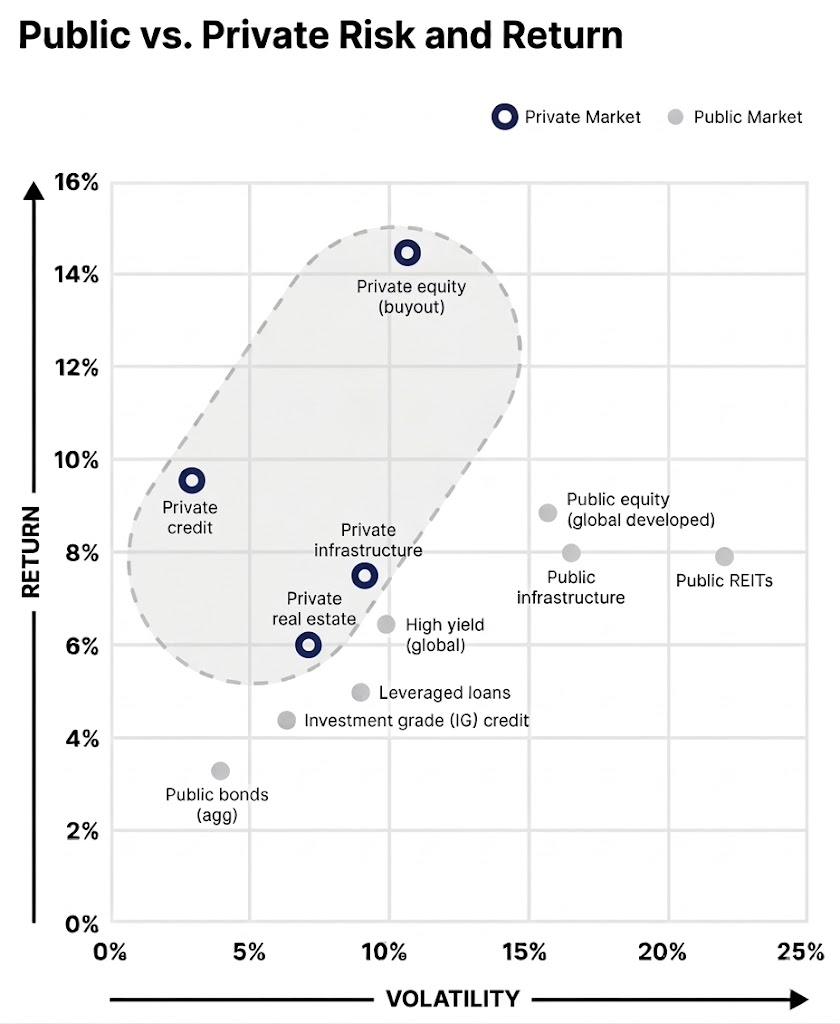
Private credit, private equity, private infrastructure, and private real estate don't all move in lockstep. They have different goals with different risk/return profiles — and that's the point.
- Private credit tends to be income-focused.
- Private equity strives to generate long-term capital appreciation.
- Private infrastructure aims to provide contractual, inflation-protected cash flows.
- Private real estate seeks to deliver current income and inflation protection, while positioning for capital appreciation as market cycles recover.
Private market asset class risk-return profiles
We can see these goals play out in the risk-return profiles of asset classes from 2004 to 2024 in the chart below.
Private market asset class correlations
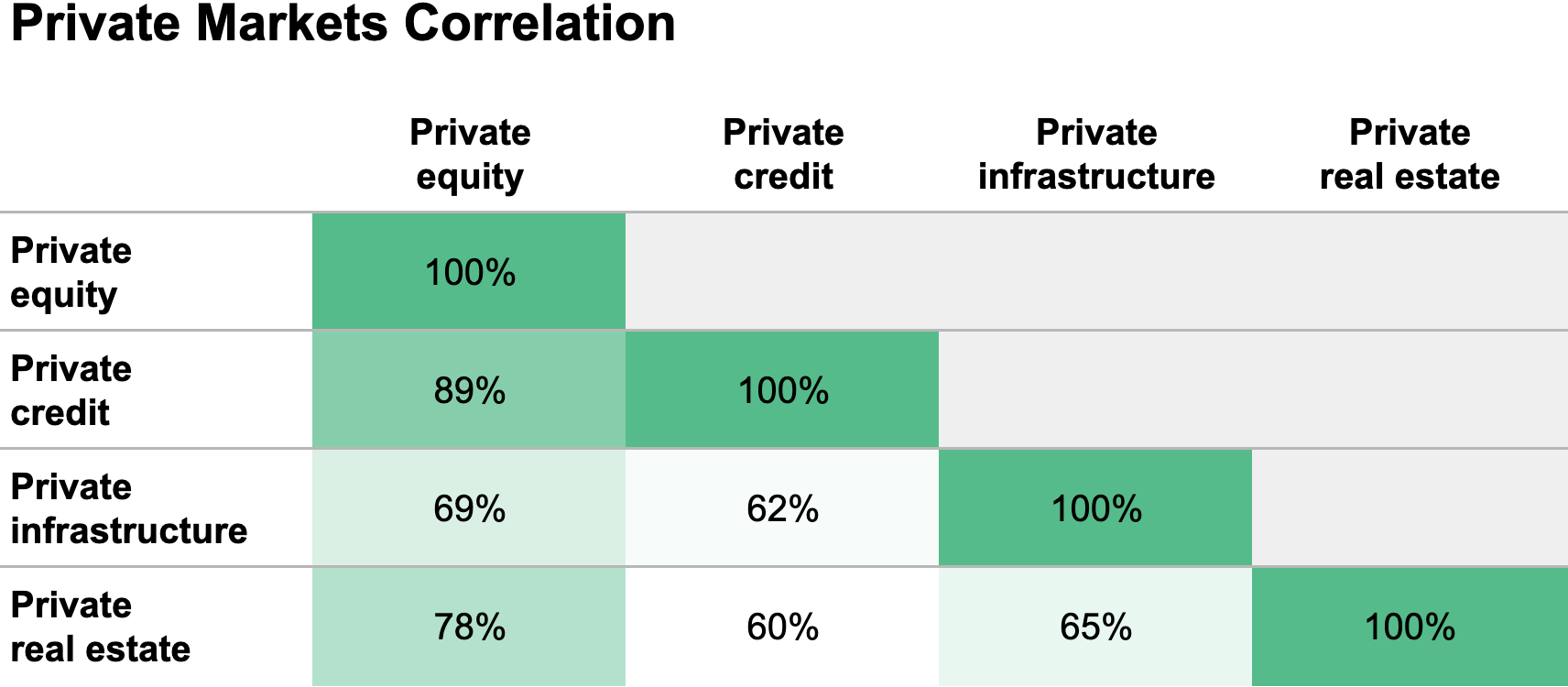
And when we compare private market asset classes, we see that some are less correlated than others when it comes to returns.
The correlation chart below shows that private infrastructure and private real estate returns are less correlated when compared to private credit and private equity. By having a mix of all asset classes in a portfolio, an investor may be able to smooth out returns compared to an investor with a single asset class allocation.
How Heron helps investors diversify across private markets
By recognizing the distinct risk-return profiles within private markets, you can combine allocations across asset classes to implement a portfolio strategy designed to perform across a range of market environments.
At Heron, we give you the ability to build a portfolio spanning private credit, private equity, private infrastructure, and private real estate — intentionally. Each allocation plays a different role. Together, they're designed to complement each other in a diversified portfolio.
Get a diversified private markets portfolio built to weather market volatility.
*Private equity refers to Burgiss All Buyout Index. Private real estate refers to NFI-ODCE Index. Private credit refers to Cliffwater Direct Lending Index. Private infrastructure refers to Burgiss All Infrastructure Index. Public Bonds refers to Bloomberg US Aggregate Bond Index. Investment Grade Credit refers to Bloomberg US Corporate Total Return Index. Leveraged Loans refers to Credit Suisse Leveraged Loan Index. High Yield refers to Bloomberg Global High Yield Corporate Total Return Index. Public Equity refers to MSCI World Index. Public Infrastructure refers to S&P Global Infrastructure Index. Public REITs refers to FTSE NAREIT All Equity REITs Total Return Index. Indexes are not available for direct investment. Past trends do not imply, predict or guarantee future results. Original source: https://www.areswms.com/private-markets-in-5-key-charts
**Private Equity, Private Infrastructure, Private Credit, and Private Real Estate refer to the respective Cambridge Associates Benchmark Index and are quoted in net return. Global Equities refers to the MSCI World Index. Listed Infrastructure refers to the S&P Global Infrastructure Index. Global Bonds refers to the Bloomberg Global Agg Index. Global Equities, Listed Infrastructure, and Global Bonds are gross returns. Source: Bloomberg, MSCI, Cambridge Associates, KKR GBR analysis. Original source: https://www.kkr.com/insights/private-infrastructure-economic-conditions