

Monthly insights: Is manager selection the most important decision in private markets? (April 2026)
In this month's insights, we explore how your portfolio outcomes can be significantly influenced by who you select to manage your exposure.

Monthly Insights #13, April 2026
In this issue:
- Manager selection: Is it the most important decision in private markets?
- How Heron approaches the manager dispersion problem
- Fund facts: See the average experience of fund managers on Heron
- Quote of the month: Tony Robbins on decisions
Before you invest in private markets...
Take a few minutes to set up an account with Heron to get a no-fee portfolio recommendation. See your prospective portfolio before you decide to invest.
Manager selection: Is it the most important decision in private markets?
Private market headlines in 2026 have been broadly negative. But treating all private investments the same misses a critical point: outcomes vary widely depending on who is managing your capital.
In public markets, the central question is typically: What should I own?
In private markets, the question shifts to: Who should manage it?
And it matters far more than most investors realize. Your portfolio outcomes can be significantly influenced by who you select to manage your exposure.
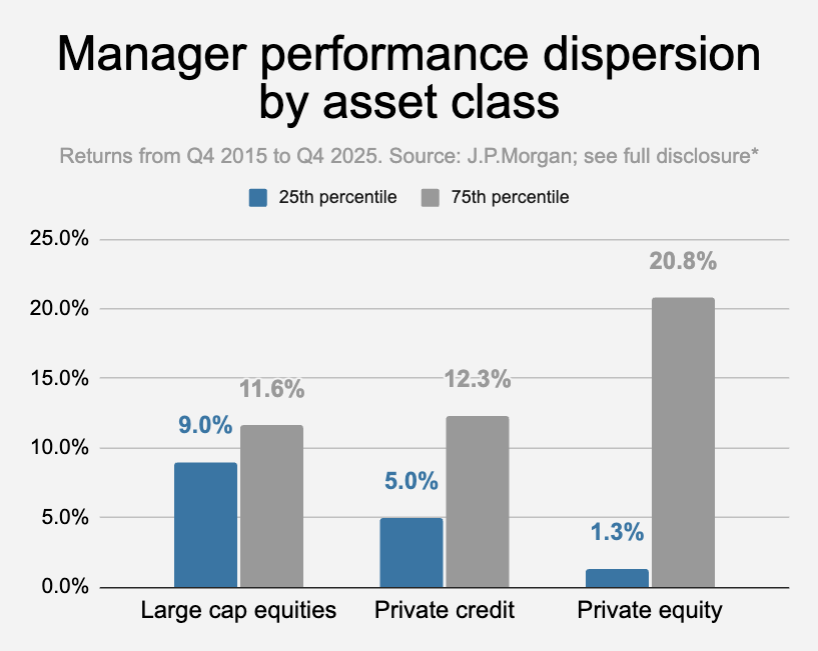
The reason comes down to manager dispersion — the performance gap between top- and bottom-tier fund managers. In private markets, that gap is dramatically wider than in public markets.
When comparing the top 25% of fund managers to the bottom 25% over the 10-year period from 2015 to 2025, research shows dispersion is roughly 3x wider in private credit and approximately 8x wider in private equity than in their public market counterparts.
To put this in perspective…
Of the 134 private market funds we score at Heron using our proprietary evaluation system (including funds we do not invest in), trailing 12-month total returns range from -15.90% to 47.76%, with an average of 9.40% and a median of 8.81%.**
That massive spread underscores that while the asset class matters, the manager determines the outcome.
It's also worth noting that headline returns don't tell the full story. For example, a hypothetical fund delivering 20% over the past 12 months may appear stronger than one returning 8% — but in a market downturn, the latter fund may prove more resilient, potentially offering greater risk mitigation and better relative performance precisely when it matters most. Investors should think about risk-adjusted returns, not just absolute returns, when considering an investment.
How Heron approaches the manager dispersion problem
At Heron, we use a proprietary scoring system to evaluate and select funds for inclusion in client portfolios — and the results have been competitive.
Let’s look at our private credit strategy as an example…
In 2025, Heron's private credit strategy returned 9.1% net of fees, compared to an average of 7.6% across a peer group of 61 private credit funds, and 6.9% for a public credit benchmark (BKLN).*** Additionally, Heron’s private credit strategy had lower realized risk across common key metrics when compared to the peer funds. (See: How Heron Finance outperformed peer private credit funds.)
Our approach is built on two core principles:
- Diversify broadly. We offer automated exposure across thousands of private credit assets, designed to reduce single-manager and single-asset risk.
- Partner with experienced managers. Heron selects from 100+ of the largest U.S. private credit funds to build balanced portfolios managed by firms averaging 20+ years of track record and collectively overseeing more than $1 trillion in aggregate private credit assets.
As we continue navigating 2026, we’ll be maintaining our focus on diversification and investing with experienced fund managers to give you access to what we believe are some of the highest quality private market funds in the world.
And if you need support with your account along the way, reply to this email or schedule a call with our team.
As always, thanks for reading,
Heron Chief Credit Officer
From the Heron Blog
- Private equity secondaries: Understanding the opportunity for investors
- Q&A: Heron Finance’s new private real estate investing strategy
Heron fund facts
Fact: 22 years is the average track record of private infrastructure managers on our platform.
Why that matters: In a cyclical market, longevity is a signal — managers who've weathered multiple booms and downturns have the hard-won experience to navigate whatever comes next.
Quote of the month
"It is in your moments of decision that your destiny is shaped."
– Tony Robbins
Before you invest in private markets...
Take a few minutes to set up an account with Heron to get a no-fee portfolio recommendation. See your prospective portfolio before you decide to invest.
*Source: Burgiss, Morningstar, MSCI, PivotalPath, JP. Morgan Asset Management. Private Credit and Private Equity are based on indices from the MSCI Private Capital Universe. Manager dispersion is based on annual returns over the 10-year period indicated for: Large Cap Equities. Manager dispersion is based on the 10-year internal rate of return (IRR) ending 3Q25 for Private Credit and Private Equity. Past performance is not a reliable indicator of current and future results. Data are based on availability as of January 31, 2026. Original source: https://cdn.jpmorganfunds.com/content/dam/jpm-am-aem/americas/us/en/insights/market-insights/principles-for-alternatives/1q26/1Q26%20Principles%20of%20Alternatives%20Investing.pdf
**Returns based on total returns, including effects of changes in net asset value and distributions, across both non-traded and publicly listed funds. Data based on SEC filings (not market prices).
***Peer group and benchmark comparisons are provided for informational purposes only and may not be directly comparable due to differences in strategy, portfolio composition, liquidity, fees, valuation methodology, leverage, risk profile, and other factors.